Boeing · USA
Boeing 747
First flight · 1968
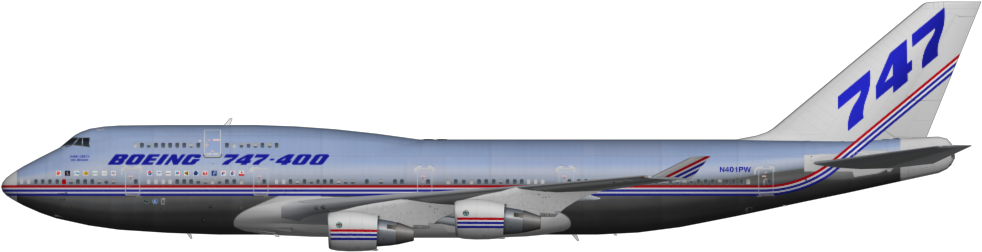
Key Fact
The 'Queen of the Skies' — the first wide-body jet, its iconic hump reshaping air travel. Production ended February 2023 after 1,574 deliveries spanning 54 years.
Overview
The Boeing 747 was born from an unlikely partnership between Boeing and Pan American World Airways, who needed something far larger than the 707. Chief engineer Joe Sutter led a team of over 4,500 engineers who designed the jet in just 28 months — a pace so relentless the team was nicknamed 'the Incredibles'. The aircraft's signature upper deck hump was originally conceived as a lounge for first-class passengers; only later did it become a flight deck sitting atop a double-lobe fuselage wide enough to carry standard freight containers side by side. The 747's high-bypass turbofan engines, led into service by the Pratt & Whitney JT9D, were themselves a technological leap — nearly three times the bypass ratio of contemporary military engines. The wing, spanning over 211 feet on the -400 variant, used a supercritical aerofoil and sophisticated high-lift devices that allowed the aircraft to operate from existing runways despite weighing up to 910,000 lbs at takeoff. Production ended on February 1, 2023, when the final 747-8F was delivered to Atlas Air — closing a 54-year manufacturing run and the longest in widebody history.
Engineering
Double-Lobe Fuselage
The 747's cross-section is a figure-eight — two overlapping circles — creating a lower lobe wide enough to carry standard freight containers side by side and an upper lobe housing the iconic hump. This single geometry solved both the passenger and cargo problems simultaneously, making the 747 the world's first aircraft designed from the outset as both airliner and freighter.
High-Bypass Turbofan Pioneer
The Pratt & Whitney JT9D entered service with a bypass ratio nearly three times that of contemporary military engines, establishing the core principle of commercial turbofan efficiency. Its introduction with the 747 proved that high-bypass engines were viable at scale and set the template that every subsequent widebody turbofan has followed.
Supercritical Wing and High-Lift System
The 211-foot wing uses a supercritical aerofoil to minimise wave drag at cruise while complex leading-edge slats and triple-slotted trailing-edge flaps allow a 910,000 lb aircraft to operate from runways designed for jets half its weight. Boeing's engineers had just 28 months to design the entire aircraft — the team was nicknamed 'the Incredibles'.
Specifications
Wingspan
211 ft 5 in (64.4 m)
Length
231 ft 10 in (70.6 m)
Engines
4× Pratt & Whitney JT9D / GE CF6 / RR RB211 / GEnx
Thrust (each)
56,750–66,500 lbf (varies by variant)
Cruise speed
Mach 0.85 (567 mph / 913 km/h)
Range
7,730 nmi (14,320 km)
Passengers
416 (3-class) / up to 660 (all-economy)
Max takeoff weight
910,000 lb (412,775 kg)
Service ceiling
45,100 ft (13,747 m)